
PNRF Case Study No. 6

Updated: Aug 28
The 1971 Eisenhower Dollar Presentation Classes
First Strikes, Presidential Gifts, and the Reconstruction of the Nixon White House Eisenhower Dollar Program
Introduction
The 1971 Eisenhower dollar occupies an unusual position in United States presidential numismatic history. Created to honor President Dwight D. Eisenhower during the administration of President Richard M. Nixon, the coin became more than a newly issued dollar. Selected examples were associated with first strike presentations, United States Mint presentations, presidential gifting, and permanent institutional preservation.
At first glance, surviving specially housed 1971 Eisenhower dollars may appear to represent variations in presentation packaging. Closer examination, however, reveals that
differences in cases, inscriptions, coin types, documentation, and provenance may correspond to distinctly different historical functions.
Research conducted under the Presidential Numismatic Research Framework (PNRF) identified multiple presentation configurations and, more importantly, reconstructed a documentary sequence connecting the United States Mint, the Nixon White House, the Dwight D. Eisenhower Presidential Library, Mint Director Mary T. Brooks, Mamie Doud Eisenhower, and recipients of specially presented Eisenhower dollars.
The resulting evidence demonstrates a fundamental PNRF principle:
Physical similarity does not establish historical equivalence. The historical function of a presidential numismatic object must be established through the combined examination of the specimen, its presentation format, documentary evidence, provenance, and presidential context.
The Research Question
The investigation began with a deceptively simple question:
Why do 1971 Eisenhower dollars associated with presidential and United States Mint presentations survive in different presentation cases?
Initial examination identified several physically distinguishable presentation formats.
Some cases carried special inscriptions such as “A First Day’s Strike.” Others incorporated presidential symbolism, including the Presidential Seal and the facsimile signature of President Richard Nixon.
The differences initially suggested a physical classification system.
Archival research subsequently demonstrated that the presentation cases were only part of a larger story.
The evidence indicated that specially handled Eisenhower dollars served different functions during the coin's inaugural year, including:
first-strike presentations;
Mint presentation pieces;
presidential gifts;
institutional exhibition specimens; and
retained White House presidential-gift inventory.
The research question therefore evolved from:
How many presentation varieties exist?
to:
What historical purpose did each presentation configuration serve?
The Eisenhower Dollar: A History Preserved Across Presidential Archives
One of the principal findings of this investigation is that the historical record of the 1971 Eisenhower dollar does not reside within a single presidential repository.
The Dwight D. Eisenhower Presidential Library preserves material associated with the creation, first strikes, Mint presentation, and institutional preservation of the new Eisenhower dollar.
The Richard M. Nixon Presidential Library preserves evidence concerning presidential records related to the consideration, acquisition, presentation, gifting, recipient categories, supply, and residual White House inventory.
Neither archival record independently presents the complete story.
Together, however, they permit reconstruction of a broader presidential numismatic history.
Part I — CREATION AND INITIAL PRODUCTION
The Mary Brooks Eisenhower Dollar Group
Material preserved by the Dwight D. Eisenhower Presidential Library under accession group 71-474 provides an important record of the inaugural Eisenhower dollar.
The cataloged group includes:
71-474.1 — a 1971 Eisenhower dollar described by the Library as a “1st strike”;
71-474.2 — a 1971 Proof Eisenhower dollar;
71-474.3a/b — two Eisenhower dollars housed in matching gold felt presentation boxes;
71-474.4 — a 1971 Uncirculated silver Eisenhower dollar in its Mint packaging;
71-474.5 — the obverse galvano; and
71-474.6 — the reverse galvano.
The objects are credited to Mint Director Mary Brooks.
The Library specifically describes 71-474.1 as an Eisenhower dollar, “1971-1st., strike.”
The Proof dollar is separately cataloged as 71-474.2.
The gold-felt pair is cataloged together as 71-474.3a/b.
The standard Uncirculated silver issue is cataloged separately as 71-474.4.
Finally, the obverse and reverse galvanos are preserved as 71-474.5 and 71-474.6.
The grouping therefore preserves multiple stages or forms associated with the inaugural Eisenhower dollar rather than a single isolated coin.

First Strikes for Permanent Historical Preservation
A United States Mint press release dated August 13, 1971 announced that Mint Director Mary Brooks would present material associated with the new Eisenhower dollar to Dr. John E. Wickman, Director of the Dwight D. Eisenhower Library.
The announcement stated that the presentation would include a pair of galvanos and first strikes of the Proof and Uncirculated 40-percent-silver Eisenhower dollars.
Importantly, the Mint stated that the galvanos and first strikes would become a permanent part of the public exhibits at the Eisenhower Center.
This establishes that important inaugural-production material was deliberately preserved for institutional and public historical purposes.
The Mary Brooks material should therefore be interpreted not merely as a group of collectible Eisenhower dollars, but within the broader historical context of the introduction and preservation of the new coin.

PART II — THE NIXON WHITE HOUSE
July 9, 1971 — Presidential Gift Intent
A July 9, 1971 White House memorandum from Bruce Kehrli to H. R. Haldeman provides direct evidence that President Nixon intended to use Proof Eisenhower dollars as gifts.
The memorandum distinguished between the $3 Uncirculated collector issue and the forthcoming $10 Proof issue.
Most importantly, it stated that:
“The President requested 10 or 12 of these for gifts.”
The memorandum further indicated that the first three were to go to Don Nixon, President Nixon's younger brother.
This document establishes presidential gift intent before the later White House acquisition and distribution records.
It also establishes that the coins contemplated for gifting were the more expensive $10 Proof issue, rather than the $3 Uncirculated collector issue.

July 27, 1971 — The Eisenhower Dollar in the Oval Office
On July 27, 1971, President Nixon met in the Oval Office with Mamie Doud Eisenhower, Treasury Secretary John B. Connally, Mint Director Mary T. Brooks, and another individual.
The presidential schedule specifically associated the Dwight D. Eisenhower silver dollar with Connally, Mamie Eisenhower, and Brooks.
Meeting notes further identify subjects including:
Eisenhower silver dollar;
Dwight D. Eisenhower Library;
presentation as gifts;
Heads of State;
Members of Congress;
first strike; and
silver.
The convergence of these subjects establishes that the Eisenhower dollar was being considered within a presidential presentation context at the highest levels of the Nixon Administration.


The Mamie Eisenhower First-Strike Presentation
Contemporary photography records President Nixon displaying a specially cased Eisenhower dollar during the July 27 Oval Office event with Mamie Eisenhower, John Connally, and Mary Brooks.
A contemporary press photograph caption identifies Nixon as presenting Mrs. Eisenhower with “the first strike of the new silver Eisenhower dollar” together with other collector items.
The photographic and documentary records therefore converge:
scheduled presidential meeting + first-strike discussion + physical presentation + contemporary press identification.
This provides strong evidence that specially housed first-strike Eisenhower dollars served a ceremonial presentation function distinct from the later Nixon presidential-gift inventory.


July 28, 1971 — Twelve Dollars Requested
The following day, July 28, a White House memorandum concerning “Eisenhower Silver Dollars” requested twelve of the new dollars and specified that they should be the $10 silver dollars.
Read together with the July 9 memorandum, the documentary progression is significant:
July 9: 10 or 12 Proofs contemplated for gifts.
July 28: twelve $10 silver dollars requested.
The preliminary quantity had therefore resolved to twelve.

July 29, 1971 — “A First Day's Strike”
One day later, Mint Director Mary Brooks wrote General Robert L. Schulz and presented him with an Eisenhower dollar associated with the first production of the new coin.
The surviving Schulz presentation case bears the distinctive inscription:
EISENHOWER SILVER DOLLAR “A First Day’s Strike”
The surviving presentation case and Brooks correspondence demonstrate that “A First Day's Strike” represented a specifically identified presentation form and should not automatically be equated with every object described more generally as a “first strike.”

PART III — FROM PRESENTATION CONCEPT TO PRESIDENTIAL GIFT INVENTORY
September 14, 1971 — Presidential Gifts and Supply
The Eisenhower dollar continued to appear in Nixon White House discussions after its introduction.
A September 14, 1971 Oval Office tape subject log records a meeting between President Nixon and H. R. “Bob” Haldeman.
Under the heading “Presidential gifts,” the log lists:
Eisenhower silver dollar;
Price;
U.S. Mint;
Value;
Special groups; and
Stephen B. Bull — Supply.
This record explicitly places the Eisenhower silver dollar within the administration of presidential gifts and indicates consideration of recipient groups and supply.
Another Nixon record associates the Dwight D. Eisenhower dollar with “Presents from the President to foreign visitors.”
Together with the July records, these documents demonstrate that presidential use of the Eisenhower dollar was not limited to an isolated presentation event.


PART IV — PHYSICAL PRESENTATION SUB-CLASSES
The archival evidence provides the historical context necessary to interpret the surviving presentation cases.
The physical differences should therefore not be treated merely as packaging varieties.
Within the PNRF, they are evaluated as possible evidence of different historical functions.
Sub-Class 1 — “A First Strike” Presentation
This configuration is associated with the inaugural presentation of the Eisenhower silver dollar and the first-strike history of the coin.
The July 27 Mamie Eisenhower presentation provides contemporary photographic and documentary evidence connecting a specially housed Eisenhower silver dollar with first-strike status.
Historical Function: Inaugural/ceremonial first-strike presentation.

Sub-Class 2 — “A First Day's Strike” Presentation
This configuration is explicitly identified by the inscription:
“A First Day’s Strike”
The General Robert L. Schulz specimen, sold at auction, provides an important documented example through the combination of:
surviving coin;
distinctive presentation case;
case inscription;
July 29, 1971 Brooks correspondence; and
recipient provenance.
Historical Function: Early-production United States Mint presentation.

Sub-Class 3 — Nixon Proof Eisenhower Dollar Presidential Presentation Gift
A separate configuration consists of the wood-grain presidential presentation case containing the 1971-S 40-percent-silver Proof Eisenhower dollar.
The exterior incorporates presidential symbolism, including a Presidential Seal medallion and the facsimile signature of Richard Nixon.
Unlike the explicitly designated first-strike cases, this configuration is associated with the Proof dollars acquired by the Nixon White House for presidential gifting.
Historical Function: Nixon presidential gift inventory/presentation.

Sub-Class 4 — Nixon Uncirculated Eisenhower Dollar Presentation Gift
A fourth configuration involves the Uncirculated Eisenhower silver dollar associated with presidential presentation use.
Its physical characteristics and historical documentation distinguish it from both the first-strike presentations and the Nixon Proof presentation sets.
Historical Function: Nixon presidential presentation associated with the Uncirculated collector issue.

Provisional Sub-Class 5
Mary Brooks Gold Felt Presentation Pair
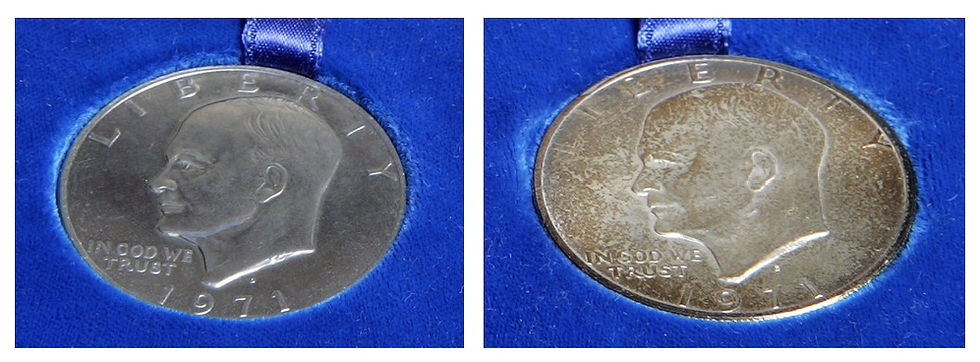
The Eisenhower Library catalog identifies 71-474.3a/b as two Eisenhower dollars housed individually in gold felt presentation boxes and credited to Mary Brooks.
High-resolution photographic examination reveals a potentially important discrepancy with the institutional description.
The library describes the coins as:
“Two (2) identical Eisenhower Silver dollars”
Photographic examination, however, indicates that one coin bears a D mintmark, while the other bears an S mintmark.
If confirmed:
the 1971-D represents the Denver copper-nickel-clad circulation issue; and
the 1971-S appears consistent with the San Francisco Uncirculated 40-percent-silver collector issue rather than a Proof.
The pair therefore would not be numismatically identical.
Their placement in matching gold felt presentation cases suggests purposeful association, but their precise historical function has not yet been established.
Possible interpretations include comparative, early-production, Mint-review, or presentation specimens. None of these functions should presently be considered proven.
Accordingly, the PNRF identifies this configuration as:
Provisional Sub-Class 5 — Mary Brooks Gold Felt Presentation Pair
Research Status: Additional documentary verification required.

PART V — THE 12–3–9 DOCUMENTARY RECONSTRUCTION
One of the strongest findings to emerge from the investigation concerns the Nixon White House Proof Eisenhower dollar inventory.
The evidence can be reconstructed numerically and chronologically.
12 — Requested
On July 9, President Nixon was recorded as requesting 10 or 12 of the forthcoming $10 Proof Eisenhower dollars “for gifts.”
On July 28, a subsequent White House memorandum requested twelve $10 Eisenhower silver dollars.
The documentary record therefore establishes twelve as the final requested quantity.
3 — Designated to Go to Don Nixon
The July 9 memorandum stated that the first three of the Proofs were to go to Don Nixon, President Nixon's younger brother.
The wording establishes their intended movement to Don Nixon but does not, by itself, establish their complete subsequent disposition or identify ultimate recipients beyond that point.
9 — Retained
The Nixon Presidential Library Artifact Finder subsequently identifies:
[Eisenhower United States Proof Dollar] [Nine]
Within the H. R. Haldeman White House Special Files, Old Box 413.
Photographic documentation supplied by the Nixon Library confirms the physical existence of a group of nine presidentially housed Proof Eisenhower dollar sets.
The individual artifacts were photographed and cataloged separately, providing physical corroboration of the archival quantity.
Thus:
12 requested −> 3 designated to Don Nixon -> 9 retained
The numerical correspondence is compelling and is independently supported by the surviving archival inventory and physical group.
The presently identified documentation, however, should not be interpreted as proving every step in the individual disposition history of all twelve coins. Recipient-level documentation remains necessary to reconstruct the complete chain.
![Figure 18. Nixon Artifact Finder — Nine Eisenhower United States Proof Dollars (snippet of artifact finder page). Nixon Presidential Library Artifact Finder entry for H. R. Haldeman Old Box 413 identifying “[Eisenhower United States Proof Dollar] [Nine].” The archival quantity independently corresponds with the residual number derived from the documented twelve-coin request and three coins designated to go to Don Nixon.](https://static.wixstatic.com/media/fad06f_66960f0234eb4081a0f55a6433da613b~mv2.jpg/v1/fill/w_398,h_270,al_c,q_80,enc_avif,quality_auto/fad06f_66960f0234eb4081a0f55a6433da613b~mv2.jpg)

PART VI — PNRF ANALYSIS
Physical Classification Is Not Historical Classification
The five identified or proposed presentation configurations demonstrate why presidential numismatic research cannot rely upon the coin alone.
A 1971 Eisenhower dollar may be numismatically identifiable by date, mint, composition, strike, and finish.
Those characteristics do not necessarily establish why that particular coin was selected, specially housed, preserved, or presented.
The presentation case may provide additional evidence.
The inscription may provide additional evidence.
The recipient may provide additional evidence.
The archival record may finally establish the historical function.
Under the PNRF, these evidentiary layers must be evaluated together.
Institutional Cataloging and Numismatic Examination
The Mary Brooks gold-felt pair demonstrates another methodological issue.
Institutional provenance is extraordinarily valuable, but institutional catalog descriptions should not automatically substitute for specialized numismatic examination.
The Eisenhower Library catalog describes 71-474.3a/b as “two identical Eisenhower Silver dollars.”
Photographic examination indicates that the coins bear different mintmarks.
If confirmed, the difference also implies different compositions and production purposes.
The institutional record establishes provenance and archival context.
Numismatic examination establishes specimen identity.
The two forms of evidence are complementary rather than interchangeable.
Cross-Repository Reconstruction
Perhaps the most important methodological contribution of Case Study No. 6 is the demonstration that the history of a presidential numismatic object may be divided among multiple archival repositories.
In this case:

Only when these records are considered together does the larger historical structure become visible.
PNRF Assessment
Classification: Level 3–Level 4 evidence represented across individual specimens and presentation groups; final classification dependent upon specimen-specific provenance.
Presidential Connection: Direct Nixon Administration involvement in the consideration, acquisition, presentation, and intended gifting of specially housed 1971 Eisenhower dollars.
Official Presidential Association: Yes. White House records document President Nixon's request for Proof Eisenhower dollars for gifts and subsequent presidential discussions concerning their presentation and supply.
Documented Provenance: Varies by specimen. Certain examples possess direct recipient documentation, while others survive as institutional White House holdings.
Evaluation Basis: Physical specimen examination, presentation-case characteristics, U.S. Mint documentation, White House memoranda, presidential schedules, tape subject logs, contemporary photography, presidential-library accession records, and recipient provenance.
Historical Significance: High. The surviving objects and documentation reconstruct multiple official uses of the inaugural Eisenhower dollar, including first-strike presentation, Mint presentation, presidential gifting, institutional preservation, and residual White House inventory.
Research Confidence: High for the documented Nixon Proof gift program and established presentation configurations; provisional for the historical function of the Mary Brooks gold-felt pair.
PNRF Methodology Contribution
Case Study No. 6 demonstrates four important principles of presidential numismatic research:
1. Presentation packaging can constitute historical evidence. Differences in cases and inscriptions may correspond to different official functions.
2. Presidential association must be reconstructed from evidence rather than presumed from the object. White House documentation establishes that selected
Eisenhower dollars were deliberately acquired for presidential gifting.
3. Institutional provenance and numismatic examination answer different questions. Archival cataloging establishes context and custody; specimen examination may refine or correct numismatic identification.
4. Presidential numismatic history may cross archival boundaries. The Eisenhower dollar demonstrates that creation, initial production, presidential use, gifting, and disposition may be documented across multiple presidential and federal repositories.
PNRF Takeaway
What initially appeared to be a study of presentation-box variations ultimately revealed a larger presidential numismatic system.
The 1971 Eisenhower dollar existed simultaneously as a newly created United States coin, an object honoring a former President, an inaugural Mint product, a first-strike presentation piece, a presidential gift, and an artifact deliberately preserved within presidential archives.
The surviving cases, inscriptions, coins, letters, photographs, Mint records, White House memoranda, presidential schedules, tape logs, and institutional inventories demonstrate that historical significance does not reside in the coin alone.
It resides in the documented relationship between the object and the historical process in which it participated.
The reconstruction of the Nixon White House Proof Eisenhower dollar group provides a particularly clear example:
12 requested → 3 designated to go to Don Nixon → 9 retained
The surviving nine presidential presentation sets provide physical corroboration of that documentary reconstruction.
At the same time, the unresolved Mary Brooks gold-felt pair demonstrates an equally important principle:
Where the evidence ends, the classification must remain provisional.
Within the Presidential Numismatic Research Framework, discovery does not require certainty to be meaningful. It requires that established evidence, interpretation, and hypothesis remain clearly distinguished.
Transition to PNRF Case Study No. 7
Case Study No. 6 establishes the physical presentation classes and reconstructs the documentary framework through which specially handled Eisenhower dollars entered presidential and institutional use.
The next research question moves from classification and program reconstruction to recipient provenance:
Who received these presidential numismatic artifacts, and what can their individual provenance reveal about the circumstances and historical significance of presidential presentation?
That question forms the basis for PNRF Case Study No. 7.
About This Case Study Series
Each PNRF Case Study demonstrates the application of the Presidential Numismatic Research Framework to a specific presidential numismatic object through documented evidence, historical context, and provenance. Collectively, the series illustrates the consistent application of the Framework across all four levels of presidential association.


Comments